Our History

Due to the generosity of landholder and philanthropist Henry Rutgers, a place for Baptist worship has been standing on the corner of Oliver and Henry Streets since 1795. Henry Rutgers, born near New York City on October 7, 1745, was the descendant of Dutch immigrants who settled in New York City in 1636 and prospered as brewers. Rutgers graduated from Kings College in 1766, was a colonel during the American Revolution, and later became politically active. He gave lands and funds to his own Dutch Reformed Church, to Presbyterian and Baptist churches, and to schools for children of the poor. Henry Rutgers dies on February 17, 1830. Rutgers College in New Jersey—formerly Queens College—was renamed in his honor.
The first church on the Henry and Oliver Street site was called the Oliver Street Meeting House. Since the establishment of that first church, Baptists have continued to appreciate Henry Rutgers’ gift and have used the original site continuously for more than 210 years.
The early church began as a mission for European seamen who docked at the nearby East River, hence the present-day name, Mariners’ Temple. Rich in history and steeped in the Baptist religious tradition, Mariners’ stands on the oldest site for continuous Baptist worship in Manhattan. It is located on the Lower East Side at the tip of Chinatown, north of the South Ferry, and walking distance from City Hall. Today, the mission thrives as Mariners’ continues to be a sanctuary for those who labor and are tired and a pinnacle of hope for all seeking the kingdom of God.
The beginning

Mariners’ Temple Baptist Church stands on the oldest site for Baptist worship on Manhattan Island. In 1795, Henry Rutgers (1745–1830), a descendant of Dutch immigrants, a former colonel in the Revolutionary War, and a philanthropist with considerable land holdings in Manhattan, donated land at Oliver and Henry Streets to the American Baptist. Baptists have worshiped continuously at this site ever since.
The first Church at Oliver and Henry Streets was called the Oliver Street Meeting House. It was located only a few blocks from the first White House on Cherry Lane, which was occupied by George Washington and his wife. Diagonally across the street from the Meeting House was the first free school for African Americans, now known as Public School 1.
The early Church began as a mission for seamen who docked at the nearby East River. The church became famous for the massive steel bell in the tower, which called for the seamen and community residents to worship. However, with the development of steam power, bigger ships needed the deeper waters of the Hudson River and maritime activity shifted westward.
In 1822 the Fayette (Street) Baptist Church moved to the Oliver and Henry Street site and renamed itself the Oliver Street Church. In 1832, the Sixth Triennial Meeting of the Baptist Missionary Society was held at the Oliver Street Meeting House. The American Baptist Home Mission Society was organized at this meeting.
According to an account written by Rev. Ira R. Steward, the first pastor of Mariners’ Temple, the New York Domestic Missionary Society decided to launch a ministry for seamen in the spring of 1841. A hall at the Corner of Cherry and Catherine Churches was secured in which to hold services. They hired Mr. John Wivil, an Englishman who had been a sailor, to serve as Chaplain. He was dismissed after eight months. After several months with spiritual leadership, Elder Jones of Newburg was hired, and was eventually succeeded by Elder Betham of Orange.
Around this time, an appeal was made in the Oliver Street Meeting House to form a Bethel society, which would be comprised of females in New York and the neighboring vicinity. From this appeal, the Baptist Female Bethel Union was formed. Their goal was to bolster the moral and spiritual welfare of the seamen in the city.
Members and supporters of the Union soon realized that in order for the ministry to be effective, a church was needed. In May 1842, a church of twenty members was organized on the condition that one George Benedict would be called as Pastor. However, the effort to obtain Benedict failed, and the enterprise languished until the spring of 1843, when the Bethel Union once again obtained the hall at Catherine and Cherry Streets and opened it for worship on the first Sunday in May of 1843. Brother John Cook, a licentiate from Macdougal Street Baptist Church was secured to serve as Chaplain. That summer five people received Christ as their Savior.
First Baptist Mariners'
After several years of ministry, seven men and six women organized themselves into an independent church, the Baptist Seamen’s Bethel. However before they became incorporated, the members unanimously voted to change the church’s name to “First Baptist Mariners’ Church, New York City.” Of the church’s original thirteen members, ten were from Macdougal Street Baptist Church, including one deacon, one trustee, the first directors of the Bethel Union, and the chaplain; two from Oliver Street, and one from Cannon Street. None were from the twenty members that had organized in 1842.
📷
On December 4, 1843, a council from most of the Baptist churches in New York and Brooklyn met in the Oliver Street Baptist Meeting-house. Dr. S.H, Cone, served as the moderator for the gathering. At that meeting, it was unanimously resolved to extend to First Baptist Mariners’ fellowship as a sister church.
Once the First Baptist Mariners’ was organized, Brother Cook agreed to continue as the church’s chaplain until they could find someone more experienced to serve as the pastor. As the congregation prayed that God would direct them to the right person, some ministers recommended Elder Ira R. Steward of Mystic, Connecticut, who was once a seaman, for the pastorate. Meanwhile, the Home Mission Society introduced Elder David Morris to serve the congregation on an interim basis.
During Elder Morris’s brief tenure, Elder Steward came to worship with the First Baptist Mariners’ congregation and, as a result, a unanimous call was extended for Steward to become their pastor. Despite being “harmoniously connected for 11 years, during which he had baptized four-fifths of the congregation,” the church in Groton, Connecticut, where Steward was serving as pastor “believed it to be their duty to give him up to engage in this important enterprise, for which they considered him to be peculiarly adapted on account of having associated so long with that class of men prior to entering the ministry.
”By 1848, the Cherry and Catherine Street hall, which measured twenty-five by fifty feet, had become too small for its congregation. It was crowded, close, and poorly ventilated, which negatively impacted Steward’s health. A joint committee of seventy brethren from Baptist churches in New York came together and resolved to build First Baptist Mariners’ a church. However, after a year with little results, the committee gave up the enterprise to an association known as “The Mariners’ Church Society.” The society existed to two years before it disbanded, having also failed to accomplish its goal.
The work was turned over to the trustees of the First Baptist Mariners’ Church, along with a lot that had been secured on Cherry Street between Pike and Rutgers and funds that had been collected. In November 1848, the congregation entered into the lecture-room of their new chapel, which cost $11,000 to complete, Steward described the chapel as being “sixty feet wide by seventy-six long, surmounted by a neat tower and flagstaff, about 105 feet high, and when finished will seat about 100 persons.”
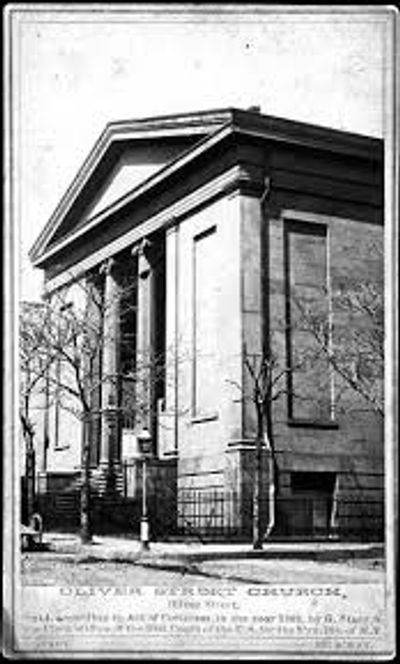
The congregation again outgrew its space and sold the Cherry Street chapel for $9,000. In 1863 (1866?), First Mariner’s purchased the Church building on the oldest Baptist ground at Oliver and Henry Streets for $32,000. The house of worship became internationally known as either the Baptist Mariners’ Temple or The Mariners’ Temple. In 1867, a special act of the New York State Legislature transferred the Church property to the American Baptist Home Mission to hold in trust for the First Baptist Mariners' Church. The pews were free forever. This legal action was instituted to make Mariners' a permanent place of worship for seamen.
"The Mother of Churches"

Due to its unique ministry to seamen, the First Baptist Mariners’ Church was considered to be ‘the first regularly organized church of the kind in the United States.” Church members were charged to go out into the streets and neighboring boarding houses to distribute tracts and invite sailors to come to the church for worship. Although Steward lamented the lack of members willing to engage in such evangelistic work, he speaks in his brief history of the females who “make some of the best laborers in this department.” He mentions “two sisters, who going out together with the spirit of Samaria, have brought in fifty or sixty persons per month.” Committees were established to distribute Bibles and religious books, each featuring a card inviting sailors to church. Nearly 200 Bibles were distributed annually in different languages and between 50,000 and 60,000 pages of religious books and tracts were given out.
Each brother of the First Baptist Mariners’ Church was also sent out as a special missionary, complete with a commission “got up in an interesting style; having on it a beautiful engraving of a meeting-house, and a baptismal scene; a letter of recommendation, and a missionary chart with instruction to regulate his course, and teach him that this is the highest business of his life.” Sailors were required to show the commission to officers and shipmates when he boarded a vessel as well as those in foreign lands. Says Steward, “In this way these converted mariners commit themselves, or show their colors at once as Christians, which has a salutary influence on them and others.” They were also required to send home written reports and to give a verbal report upon their return. To encourage the sailors to file their written reports, a correspondence committee was established to answer every letter.
As shipping activities moved west to the Hudson River, ministry to seamen was phased out, giving rise to another innovative brand of ministry. This new brand of ministry emerged in response to the great influx of European immigration. Mariners’ Temple gained the reputation as “The Mother of Churches.” Mariners’ launched the first Swedish, Italian, Latvian, Russian and Chinese Baptist Churches, and the Norwegian-Danish Mission of New York City as each new arrival of immigrants moved through the Lower East Side.
Mariners’ is also credited with exporting the Baptist movement to Scandinavia in the mid-nineteenth century through Scandinavian seamen. In 1844, Captain Gustavas W. Schroeder, a Swedish seaman attended a meeting at Mariners’ Temple. He was baptized and joined Mariners’ shortly after that first meeting. In 1861, Schroeder returned to Sweden as a Baptist missionary and built a Baptist Meeting House. Captain Schroeder called Mariners’ the “Mother of Swedish Baptist Churches both in Sweden and America.”
Captain Schroeder was instrumental in the spiritual awakening of another seaman, F.O. Nilsson. Nilsson was baptized in July, 1847, in Hamburg, Germany and established the first Baptist Church in Sweden in 1848. By the end of February 1849, the congregation of the fledgling church had grown from six to twenty-eight. When Nilsson was temporarily banished from Sweden, he returned to the United States and continued his mission work among Swedish communities in Minnesota. Throughout the late nineteenth century, Mariners’ Temple continued to make a significant impact on the development of the Baptist movement in Sweden. Many of its proponents, such as Anders Wilberg and John Alexis Edgren, received support, evangelistic fellowship, guidance and training at Mariners’. Mariners’ also supported missionaries who took Baptist teachings to Norway, Denmark, and Chile.
In 1867, the First Swedish Baptist Church was organized at Mariners’ under the leadership of Captain R.E. Jeanson of Gothenberg, who converted to the Baptist faith and settled in New York in 1865. Initially worshipping at Mariners’, the congregation eventually became Trinity Baptist Church in 1942.
In 1884, Mariners’ Temple became a City Mission Field of the Baptist City Mission Society. By 1890, Mariners’ was declared one of the two important City Mission Fields in the world.
The First Italian Church was organized in Mariners' Temple in 1897, and became the frontier church for Italians of the United States. The ministry welcomed Italian immigrants as they left Ellis Island.
In 1903, the First Norwegian-Danish Baptist Church got its start at Mariners’ Temple. It later became the First Norwegian Baptist Church. An article entitled “City Mission Work” that appeared in the Baptist Home Mission Monthly at the time described Mariners’ Temple as “The Mother of Churches.”
Through the New York City Mission Society Frederick Blumberg, a Latvian (Lettish) tailor who preached to his countrymen, was given free accommodation at Mariners’ Temple in 1904. The First Lettish Church was established at Mariners’ in 1905.
In July 1915, Mariners’ Temple was among the five Russian centers established in New York City. The others were the Second Avenue Baptist Church, the Beck Memorial Presbyterian Church, the Judson Memorial Church, and The Olivet Memorial Church. By 1916, the First Russian Church was organized in Mariners' Temple.
In 1920, Lin Loo went to China from Mariners’ Temple to establish a little Mariners’ in Canton. In 1926, the First Chinese Church was organized at Mariners’ Temple.
From the 1940s to the 1970s, Mariners’ Temple continued to be a spiritual center welcoming all ethnic groups in the neighborhood. Mariners’ Temple became a Christian center for Chinese, Puerto Ricans, and African Americans. With the arrival of Spanish-speaking people in the community, Mariners’ established a Spanish mission. The Spanish program began with two weeknight classes and a service on Sunday morning concurrent with the English service. By the early 1960s, both English and Spanish speaking congregations took communion together in a bilingual service. With the Chinese Baptist Mission, worship services were regularly held in three languages.
In 1985, the Lunch Hour of Power (LHOP) congregation was initiated. Wednesday noontime services were established as a midweek spiritual refuge for the many government and corporate employees in lower Manhattan.
In 1994, Mariners’ sponsored the establishment of a Thursday noontime service in the Bronx. Baptist worship or fellowship was not offered in this area of New York City. The Bronx Community Baptist Church was launched as a result of the Thursday noontime services. Mariners’ Temple continued its role as the “Mother of Churches” with the launching of this new congregation.
Self governance & The Church Building

As the Church moved into the 1970s, the congregation decided to move towards self-governance. At this time, Mariners’ was still being held in trust by the American Baptist Home Mission Society and governed by the New York City Baptist Society. However, in 1971, the congregation began to demand more self-governance. During this period, Mariners’ began to experience significant growth.
Mariners’ Temple became self-supporting in 1980. A new era began with the installation of the Reverend Suzan Denise Johnson Cook in 1983—the first female pastor in the church’s history. Under her leadership, the Church grew from an active membership of sixty to more than 1,000 members between the two congregations.
In 1986, Mariners’ Temple was able to raise funds to payoff the mortgage on its property at 2 Oliver Street, known as the JUDD House.
In May 1992, under the tenure of the Pastor Johnson Cook, Mariners’ Temple Baptist Church congregation celebrated the title transfer of the Church building from the American Baptist Churches Metropolitan New York to the Church.
The present Church structure, the fourth building on the site, was built in 1844. Minard Lefever (1798–1854), one of the most influential architects in the United States at that time, designed the structure. Using the Lefever’s design, Isaac Lucas built the Church structure.
Lefever began his career as a carpenter around 1820. In 1829, he published five pattern books, which were instrumental in spreading the Greek Revival style: The Young Builders' General Guide Instructor in 1829, The Modern Builders’ Guide in 1833, The Beauties of American Architecture in 1835, and The Architectural Instructor in 1850.
In the mid-nineteenth century, there were no professional schools of architecture and few who claimed the title architect. Most structures were designed and put up by builders, and architects and builders were trained by working under master builders. Builders across the United States also depended on pattern books published by Eastern architects like Lefever.
Lefever employed a Greek revival design that replicates the hand-carved Corinthian colonnade temples of Greece.
The Mariners’ Temple Baptist Church building was recognized as a Federal landmark in 1966 and a New York State landmark in 1977. It is one of the few landmark examples of nineteenth century Greek Revival architecture remaining in New York City.
Moving Forward

Pastor Johnson Cook became a mentor and champion of African American women in the ministry. Sheila Denise Grimes trained under the tutelage of the Rev. Dr. Johnson Cook, and was licensed to preach the Gospel on March 6, 1988, at the Mariners’ Temple Baptist Church. She is the first woman licensed to the Gospel Ministry of this historical American Baptist church. While serving as an Adjunct Professor at the New York Theological Seminary, Pastor Johnson Cook met Henrietta Carter, a student at the seminary, and invited her to come to Mariners’ Temple as an intern through the Black Women in Ministry Project, which was sponsored by the New York City Mission Society. On March 11, 1990, Pastor Johnson Cook ordained Reverend Henrietta Carter into the Christian ministry.
In 1996, Pastor Cook resigned to plant a ministry in the Bronx. The Mariners’ Temple Joint Board elected Assistant Pastor Henrietta Carter to serve as Interim Pastor. After a careful and extensive search within the Baptist community, the Nominating Committee designated Interim Pastor Carter to be the twenty-seventh Pastor of Mariners’ Temple Baptist Church. Pastor Henrietta Carter was installed on November 1998.
Pastor Carter has been instrumental in revitalizing Mariners’. Under Pastor Carter, Mariners’ has endeavored to become a multicultural small group-driven ministry building community through evangelizing, equipping and empowering believers for service in the Church and in the community. Mariners’ Strategy is:
To grow:
Warmer through Fellowship
Deeper through Discipleship
Stronger through Worship
Broader through Ministry
Larger through Evangelism
Street Co-Naming & Block Re-dedication
On Saturday, September 23, 2026, Oliver Street was Co-Named "Mariners' Temple Lane."

